Practical Wellbeing
THERAPY, TRAINING AND MENTORING

AS A THERAPIST
Some people grow up in difficult families. Even though they are now grown up and their childhood is far away, they may still feel there is something wrong with what they think, how they feel, and how they act in the world.
I help my clients repair their emotional wounds so that their past struggles are no longer running their current lives, they are less at war with themselves, and they can become an ever more whole and capable person, at ease with themselves and others.
“I came to Andy with what seemed to be a messy ball of stubborn issues that would not budge, even after trying everything I could think of to fix them over the years.
With Andy’s guidance, patience and unjudgemental attitude I have slowly started to unravel the messy ball one thread at a time and healed the deep issues from my childhood that have held these issues in place.”
– Natalie
MY CORE PRINCIPLES
1. Our emotional problems are often the result of solutions to earlier problems

If we grow up in difficult circumstances, we may have to learn strategies to survive those circumstances.
As children, we spontaneously learn patterns of feeling, thinking and acting that help us out in those stressful, dangerous moments.
Your childhood survival strategies become deeply entrenched and can work against you in your adult life. They turn up in all sorts of ways as fear of conflict, people pleasing, social anxiety, poor boundaries, and many more.
For example: if a child didn’t feel safe when they were growing up, they may have learned to be exquisitely alert to signs of danger, so they could run and hide from the threat. This solution worked well for them back then.
Time passed, and eventually, they escape into a much safer, kinder world. But, even when they are an adult in real safety, their ’threat meter’ is still set far too high! Things that are safe, seem dangerous, and they want to run and hide, even if their adult self knows they are overreacting. They just don’t feel safe in the world, even if they want to.
Unfortunately, because these childhood patterns and parts of you were formed to keep you safe and help you survive, they are difficult to let go of.
2. Healing is possible, even if you think it isn’t

heal (verb):
Old English hælan “cure; save; make whole, sound and well,” from hailjan, literally “to make whole”
These old ‘survival strategies’ can show up as feelings and thoughts we don’t want, things we do that we don’t want to do. We can feel pulled in different directions by conflicting parts of ourselves. To make things worse, we give ourselves a hard time, or even hate ourselves for it.
You might have tried many things with little or no success, probably because the roots of these problems are deep and like weeds they spring back after you cut off the leaves.
A deeper healing (being made whole) needs a different approach.
The parts of you that struggled to survive during your upbringing need to be freed from all their stress and distress and given what they needed at the time but never had, so they can let go of the old response and grow up into your adult self (this is the essence of the Identity Healing approach).
3. The problems themselves can be the route to deep healing

If your emotional issues are caused by these parts formed in childhood, the way they show up in your adult life can lead you directly to the part of you that needs the help.
By working directly with those struggling parts of ourselves, we can become more adult, being able to respond to life rather than reacting to it, and become more whole as the person we were meant to be.
To find out more go to Personal Therapy
AS A TRAINER AND MENTOR
After 15 years as an EFT International Master Trainer, and as the creator of the Identity Healing® processes, I train and mentor helping professionals in the advanced processes and approaches that I use with my clients to heal their deep emotional wounds.
As an EFT International Approved Mentor, I offer supervision and mentoring for coaches, therapists, counsellors, and others who are using EFT in their professional roles.
I am also an approved mentor for trainees and practitioners of IEP (Intention Tapping).
ANDY HUNT

I have been working as a therapist since 2002. Like many therapists, I was drawn to the issues that affected me personally, so I specialise in helping people who didn’t feel good enough as children and still don’t feel good enough now to change the way they think, feel, and act so they can be kinder to the person they are and become the person they want to be.
As the creator and lead trainer of the ‘Identity Healing’ processes, I train and mentor people in the helping professions to add these advanced tapping techniques to their therapeutic toolkits.
After 15 years as an EFT International Master Trainer and Approved Mentor, I support EFT Practitioners in using their skills in their professional work.
I am also a mentor for practitioners of the ‘Intention Energy Processes’ AKA Intention Tapping, developed by Steve Wells.
Finally, as someone who has used these processes for my own personal development, I would like to share some of the approaches and techniques I have used with people who are committed to their own self-development.
I am making this journey myself …
For a very long time, I had the feeling that I wasn’t good enough. I often felt a subtle undertow of shame and a need to avoid disapproval, and sometimes I had to pretend to feel OK.
It wasn’t crippling; I got by well enough, but it wasn’t much fun either.
Although I didn’t fully understand what was going on, I did realise that suffering was overrated and wanted to do something about it.
Since I left school (a very long time ago), I have tried many different forms of self-help and inner work, including counselling, meditation, NLP, EFT, hypnotherapy, and a host of other techniques and approaches to become more self-accepting and resourceful.
After a lot of learning, I started to become the person I always wanted to be (it is, and probably always will be, a work in progress).
Along the way, I reached the point where I wanted to help others achieve the same kind of results I was getting.
In 2002, after a lot of training, I started working professionally with people, providing therapy and training to help change the way they think and feel about themselves so that they could lead happier inner lives and be more accepting and resourceful.
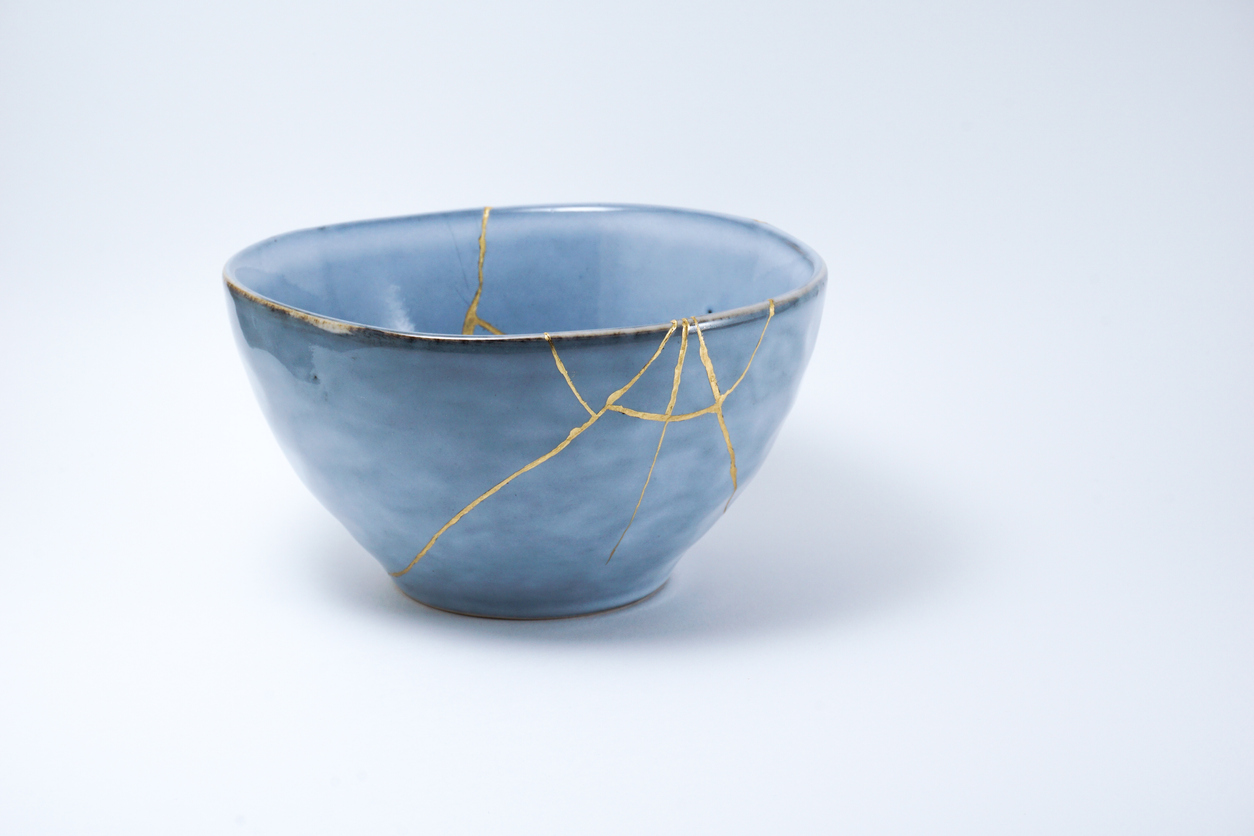
Repairing what has been broken
In traditional Japanese aesthetics, wabi-sabi (侘寂) is a world view centered on the acceptance of transience and imperfection. The aesthetic is sometimes described as one of appreciating beauty that is “imperfect, impermanent, and incomplete” in nature.
This bowl is an example of Kintsugi (金継ぎ), the Japanese art of repairing broken pottery by mending the areas of breakage with lacquer dusted or mixed with powdered gold, silver or platinum.
As a philosophy, it treats breakage and repair as part of the history of an object, rather than something to disguise.
Image by Marco Montalti


